







Starting with the Wikipedia definition seems to be the best way to start an article like this, mostly to make sure both you and I understand what it is that we want to discuss.
A tarantula hawk is a spider wasp which hunts tarantulas as food for its larvae. Tarantula hawks belong to any of the many species in the genera Pepsis and Hemipepsis in the family Pompilidae (spider wasps).
The more familiar species are up to 5 cm (2 in) long, with blue-black bodies and bright, rust-colored wings (other species have black wings with blue highlights), making them among the largest of wasps. The coloring on their wings warns potential predators that they are dangerous (aposematism). Their long legs have hooked claws for grappling with their victims. 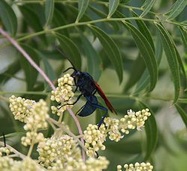 The stinger of a female tarantula hawk can be up to 7 mm (1/3 in) long, and the sting is considered the second most painful insect sting in the world. (Wikipedia, I thank you for your information.)
I guess the one thing that concerns most people about the Tarantula Hawk is “can it sting?”, and as we read above, the answer is most definitely YES! The female spider killer is unquestionably capable of and can give a very vicious sting, but it rarely ever does so. I wouldn’t go so far as to call the tarantula hawk tame but it is fairly passive and rarely stings unless somehow provoked. There have been instances where one has mistakenly landed on a person, and just set there for a short time before moving on.
BUT – when provoked, the most common one (yes, the one that lives in the Southwest) can deliver one of the worst imaginable stings possible. One witness said that it is among the “most painful of any insect” sting. It is fairly short in duration, but with a time frame of only approximately 3 minutes, it was described as “immediate and excruciating” and shuts down any ability to do “anything except scream”. (Justin Schmidt) He continued “Mental discipline simply does not work in these situations.”  One report said that many people that have been stung can even lose control of body functions. Another described it as being as bad as “over a dozen stings of Red Ants, all at the same time and in the same place”.
I was quite surprised to find that very few of the animal life is able to eat them mostly because of a very large stinger. One source said that the stinger can be up to a 1/3 of an inch long and very effective. Another surprise is that the “Road Runner” bird devours them with no ill effects. Many wasps, bees and beetles will tend to mimic them as a protection from other predators.
The tarantula hawk lives in many areas of the world but prefers a more dry arid weather environment. They live mostly in India, Africa, Southeast Asia and both the Americas. In the U.S., they have been seen on the North American west coast in (Lakewood) Washington state and as far south as Argentina.
Bryson put together a video on the Tarantula Hawk:
The female tarantula hawk will capture and sting to paralyze but not kill the spider. It will then take the spider to her own burrow or nest and lay a single egg on the spider’s abdomen. She then leaves the burrow after thoroughly covering the opening. When the larva hatches, it will use the spider for 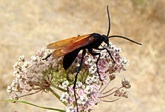 food until it is an adult. One report said the larva will not eat the organs until last to keep the spider alive longer.Sometimes, the hawk will feed on fermented fruit when it is readily available and can become highly intoxicated to the point that flight is a challenge. They are most active in daylight hours in the summer months, but will avoid higher temperatures. In the heat of the day, they seek shelter of some kind and become slow and sluggish. The male does not hunt but feeds on milkweed, soapberry trees and mesquite trees. The female will (at times) - also feed the same food as the male. The chief occupation of the male seems to be setting on the tops of tall plants - watching for the ladies that are ready to reproduce. The technical term for this is “hilltoping”.
Roy
June 2013
Partners
Resources
www.greenhomebuilding.com/adobe.htm
www.earthbagbuilding.com/articles.htm
www.earthbagplans.wordpress.com
We moved from the city to the country in 2005. Since then, we have been building structures, raising livestock and growing some of our own foods. We are crazy about family, nutrition and want the best for our growing family.
